

Weaver Lake Overview
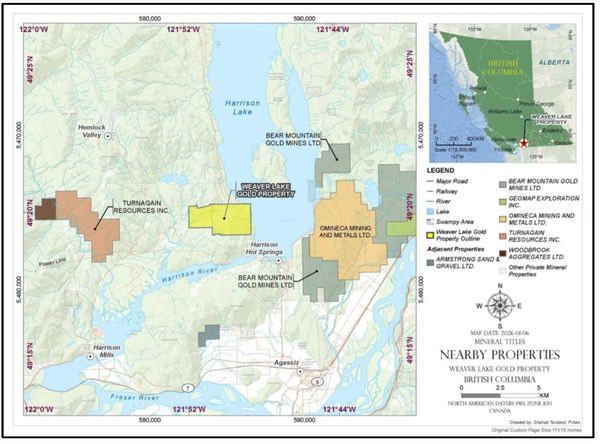
The Weaver Lake Project is a 725-hectare gold-silver exploration property in the New Westminster Mining Division. The project is located 13 km north of Highway 7 near Harrison, British Columbia. Access is via paved highways and forestry roads, with most areas accessible by vehicle, and regional infrastructure and servi
Historical Results
Historical exploration activities at Weaver Lake have returned impressive intercepts, such as 16.6 g/t gold and 91.9 g/t silver over 1.52 meters and 11.8 g/t gold and 44.6 g/t silver over 2.13 meters from the 1975 program, along with 8.61 g/t gold and 46.2 g/t silver over 3.05 meters and 2.06 g/t gold and 21.4 g/t silver over 6.10 meters from 1996 drilling.
More recent 2018 results included 2.49 g/t gold and 7.52 g/t silver over 1.53 meters, underscoring the property's consistent mineralized intervals.

Geology and mineralization
The Weaver Lake Property is situated within the East Harrison Lake Belt of the southern Coast Belt. Based on the geological, structural, and historical exploration information reviewed, mineralization on and adjacent to the Property is interpreted to be primarily orogenic (mesothermal) gold–silver in nature, hosted within quartz–carbonate ± sulphide veins localized along regional and subsidiary shear zones related to long-lived deformation corridors. Historical trenching, underground development, and diamond drilling have confirmed the presence of gold–silver mineralization within shear-hosted quartz–carbonate vein systems, and historical results include multi-gram gold and multi-hundred-gram silver values over narrow intervals.
The broader East Harrison Lake Belt also hosts ultramafic and mafic intrusive bodies known to contain magmatic nickel–copper sulphide mineralization, as exemplified by the nearby Pacific Nickel (Giant Mascot) Mine. Although no economic nickel–copper sulphide resources have been delineated on the Property to date, this mineralization style is considered a secondary exploration target based on regional context and analogues.
History
The Weaver Lake Property is located within the Hope–Harrison Lake area of southwestern British Columbia, a region with a long and well-documented history of mineral exploration dating back to the Fraser River gold rush of 1858. Since that time, the district has been the focus of numerous exploration programs targeting precious and base metal mineralization associated with volcanic, volcaniclastic, and intrusive rock assemblages. This extensive regional exploration history provides important geological context for the Property.
The Property area hosts one documented mineral occurrence, the LD Showing (MINFILE 092HSW070), located on the west side of Harrison Lake. Mineralization is hosted within Lower to Middle Jurassic volcanic and volcaniclastic rocks of the Harrison Lake Formation and is structurally controlled by a complex fault system trending approximately 070°, with subsidiary splays and cross-faults. Mineralization is characterized by quartz–calcite ± sulphide vein systems containing pyrite, sphalerite, and chalcopyrite.
Early exploration on the Property began in the early 1970s.
In 1973, trench sampling on the Rye 2 claim returned high-grade precious and base metal values, including 63.77 g/t gold, 2,009.44 g/t silver, and 7.23% zinc, which led to increased exploration interest. Follow-up diamond drilling in 1975 (185 m in total) intersected multiple gold–silver mineralized intervals over metre-scale widths, confirming the presence of shear-hosted mineralization.
Subsequent work included a ground magnetometer survey and limited underground development (1979–1980). Renewed exploration in the early 1990s by Flame Petro-Minerals Corp. involved soil geochemistry, geological mapping, and electromagnetic surveys, which delineated linear gold soil anomalies extending up to 600 m. This work was followed by eight diamond drill holes totaling 762 m in 1996, testing these anomalies.
In 2008, a further diamond drilling program consisting of five NQ holes totaling 858 m tested both western and eastern extensions of the mineralized zone. This program did not return significant mineralized intersections. In 2018, a two-hole diamond drilling program (236.22 m) tested the eastern extension of the historically mineralized shear zone. One hole intersected altered and brecciated volcanic rocks with quartz–carbonate–rhodocrosite veins and returned gold–silver mineralization over narrow intervals, confirming the presence of shear-hosted mineralization, albeit at lower grades than historical results.
Overall, historical exploration has demonstrated that the Weaver Lake Property hosts structurally controlled gold–silver mineralization within quartz–carbonate vein systems. While results have been variable and mineralization is discontinuous, the collective data indicate that the hydrothermal system was capable of depositing locally high-grade mineralization. The 2018 drilling confirmed mineralization continuity and supports the potential for additional mineralized zones along strike and at depth, warranting further exploration.
Earn-in Agreement
The Weaver Lake Property was optioned by Aurwest in early 2026 to acquire up to a 50% right through a combination of exploration commitments and payments over a three year period.